Shopping for a baby can feel overwhelming. Shelves are filled with products promising to be gentle, natural, hypoallergenic, moisturizing, soothing, organic, or specially designed for newborns. Yet a cute package and reassuring words on the front of a bottle do not tell you everything that is inside.
For parents and caregivers, learning how to read baby product labels is one of the simplest ways to make more informed purchasing decisions. Whether you are buying baby shampoo, lotion, diaper cream, wipes, baby powder, bath products, or other personal-care items, the ingredient list can reveal information that the front label does not.
The goal is not to become a chemist or worry about every unfamiliar word. In fact, many long ingredient names are perfectly legitimate and useful ingredients. Instead, parents can learn to recognize certain categories of ingredients, understand common label terminology, and pay particular attention to products that come into frequent contact with a baby’s sensitive skin.
The American Academy of Pediatrics recommends choosing fragrance-free products with simple ingredient lists for children’s personal care, particularly when dealing with sensitive skin.
This guide explains how to read baby product labels, which ingredients deserve closer attention, what terms such as “fragrance-free” and “hypoallergenic” actually tell you, and how to build a simpler baby-care routine.
Why Reading Baby Product Labels Matters
Babies can have more sensitive skin than adults, and many baby products are used repeatedly. A lotion might be applied several times a day. Shampoo may be used regularly. Wipes can come into contact with the diaper area every day.
That means parents may want to consider not only whether a product works, but also what ingredients their baby is exposed to repeatedly.
Reading the label can help you:
- Identify fragrances and potential irritants
- Recognize preservatives
- Check for ingredients your baby has previously reacted to
- Compare products with simpler formulas
- Understand whether a product contains ingredients you personally prefer to avoid
- Follow age and usage directions
- Distinguish marketing claims from the actual ingredient list
The FDA requires retail cosmetic products in the United States to carry ingredient declarations, although certain ingredients can be listed under general terms such as “fragrance” or “flavor.”
This is important because the front of a package is primarily designed to communicate the product’s purpose and marketing claims. The ingredient panel provides a much more useful starting point when you want to understand what is actually in the product.
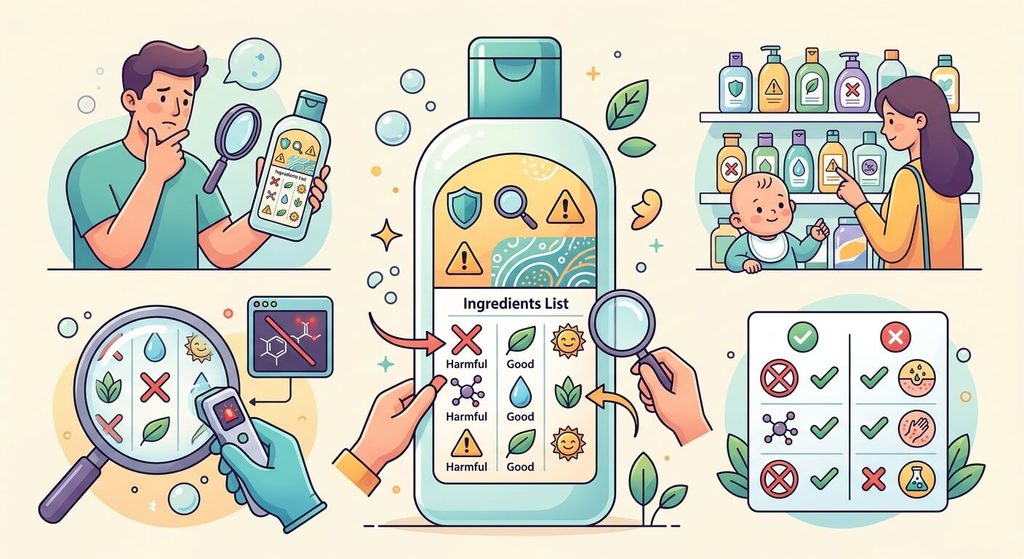
Start With the Ingredient List, Not the Front of the Package
Words such as “gentle,” “pure,” “natural,” “clean,” and “baby safe” can sound reassuring, but they should not be your only basis for choosing a product.
Instead, turn the package around and find the ingredient list.
For baby lotions, shampoos, washes, creams, and similar cosmetics, ingredients are generally listed in descending order of predominance. Ingredients present at 1% or less can be listed without regard to their exact order.
This gives you a useful way to quickly scan a formula.
For example, you might see something like:
Water, glycerin, sunflower seed oil, cetyl alcohol, preservative, fragrance
The first several ingredients generally make up a larger portion of the formula than ingredients appearing later.
However, don’t assume that an ingredient is automatically harmful simply because it has a complicated name or appears near the beginning. Ingredients serve different purposes, and some unfamiliar-sounding ingredients are essential for keeping a product stable, moisturizing, or safe from microbial contamination.
The better question is:
What does this ingredient do, and is it appropriate for the product’s intended use?
1. Pay Close Attention to “Fragrance” and “Parfum”
Fragrance is one of the easiest things for parents to overlook.
A baby lotion might be marketed with phrases such as “soft baby scent” or “calming aroma,” while the ingredient list simply says fragrance or parfum.
Under U.S. cosmetic labeling rules, fragrance mixtures can generally be listed collectively as “fragrance” rather than identifying every individual component. The FDA explains that fragrance formulas can contain numerous natural and synthetic ingredients and may be protected as trade secrets.
That does not mean every fragrance-containing product is dangerous.
It does mean that parents who want to minimize unnecessary fragrance exposure may find it easier to choose products specifically labeled fragrance-free and then check the ingredient list.
The American Academy of Pediatrics recommends fragrance-free body washes, soaps, lotions, and diaper creams, particularly for children with sensitive skin.
Why fragrance can matter for babies
Fragrance ingredients can cause irritation or allergic reactions in some people. The FDA identifies fragrances as one of the common categories of cosmetic allergens.
If your baby develops redness, itching, dryness, or irritation after using a particular product, consider stopping the product and discussing persistent or significant symptoms with your child’s healthcare professional.
What to look for
When comparing products, look for:
- Fragrance-free
- No added fragrance
- Simple formulas with fewer unnecessary scented ingredients
Remember that fragrance-free and unscented are not necessarily identical claims. Always look at the ingredient panel rather than relying exclusively on marketing language.
2. Understand Parabens Before Deciding Whether to Avoid Them
Parabens are preservatives used to help prevent microorganisms from growing in cosmetic products.
Common examples include:
- Methylparaben
- Ethylparaben
- Propylparaben
- Butylparaben
The FDA describes parabens as preservatives commonly used in cosmetics and notes that they are generally easy to identify on ingredient lists by their names.
Preservatives actually serve an important purpose. A product containing water and other nutrients can become contaminated with bacteria or mold if it is not properly preserved.
So the presence of a preservative does not automatically mean a product is unsafe.
Parents who prefer to avoid particular parabens can simply look for these names on the ingredient panel and choose another formulation.
The most useful habit is to understand why an ingredient is there, rather than assuming that every chemical-sounding ingredient is harmful.
3. Know What Phthalates Are—and Why Fragrance Makes the Label More Complicated
Phthalates are a group of chemicals used for different purposes, including as plasticizers and, in some circumstances, components of fragrance formulations.
The FDA notes that diethyl phthalate (DEP) has historically been used in fragrances and that fragrance ingredients may not all be individually disclosed on a cosmetic label.
The FDA also reports that phthalate use in cosmetics has decreased considerably since its earlier surveys.
This is a good example of why parents should avoid blanket statements such as “all phthalates are dangerous.”
Different phthalates have different uses and safety profiles.
If your goal is simply to minimize exposure, choosing fragrance-free products can make the ingredient list easier to evaluate because fragrance mixtures may contain ingredients that aren’t individually identified on the label.
The American Academy of Pediatrics similarly recommends fragrance-free personal-care products as a practical choice for families.
4. Learn About Formaldehyde-Releasing Preservatives
Some preservatives used in cosmetics can release small amounts of formaldehyde over time.
Examples that may appear on ingredient lists include:
- DMDM hydantoin
- Imidazolidinyl urea
- Diazolidinyl urea
- Quaternium-15
- Bronopol
- Sodium hydroxymethylglycinate
The FDA lists formaldehyde and several formaldehyde-releasing ingredients among potential cosmetic allergens or sensitizers.
Again, seeing one of these names on a label does not automatically mean the product is unsafe. The concentration, formulation, route of exposure, and individual sensitivity all matter.
Parents who want to minimize potential sources of irritation can compare formulas and choose products without these ingredients.
5. Watch for Methylisothiazolinone and Methylchloroisothiazolinone
Two preservative ingredients that parents may encounter are:
Methylisothiazolinone (MIT)
Methylchloroisothiazolinone (CMIT)
These ingredients are used as preservatives and are recognized by the FDA among potential cosmetic allergens.
This is particularly worth knowing if your baby has a history of skin sensitivity or has reacted to personal-care products in the past.
If a product repeatedly seems to cause irritation, don’t assume that the problem is simply “dry skin.” Review everything that comes into contact with the affected area, including:
- Soap
- Shampoo
- Lotion
- Baby wipes
- Laundry detergent
- Diaper cream
- Sunscreen
- Fragranced products
A pediatrician or dermatologist can help identify possible causes when irritation continues.
6. Be Careful With “Natural” and Essential Oil Claims
One of the biggest misconceptions about baby products is that natural automatically means safer.
It doesn’t.
Plant extracts and essential oils are still chemically active substances. Some can irritate sensitive skin or cause allergic reactions.
A product containing lavender, citrus, peppermint, eucalyptus, tea tree, or another botanical ingredient is not automatically inappropriate for every baby. But parents should remember that “plant-based” does not mean “risk-free.”
The FDA notes that natural and synthetic fragrance ingredients can both be part of cosmetic fragrance formulations, and some fragrance components may cause sensitivity in certain individuals.
For newborns and babies with sensitive skin, a simple fragrance-free product may be easier to evaluate than a heavily scented product containing numerous botanical extracts.
7. Understand Dyes and Colorants
Color can make a baby product look fun, but it isn’t always necessary.
You may encounter ingredients such as:
- FD&C color additives
- Dyes identified by numbers
- Iron oxides
- Other permitted colorants
Color additives are regulated separately from many other cosmetic ingredients. The FDA maintains specific requirements concerning cosmetic color additives.
If your baby has particularly sensitive skin, choosing products with fewer unnecessary additives may simplify your routine.
There is generally little reason for a basic baby wash or lotion to have an elaborate color if your primary objective is gentle skin care.
8. Don’t Ignore Talc and Baby Powder
Baby powder deserves special attention because the concern isn’t simply about what is absorbed through the skin.
It can also be about inhalation.
The American Academy of Pediatrics advises against using baby powder and specifically warns about talc-containing products because inhaling substantial amounts of talc can cause serious lung problems.
For routine diaper care, parents can consider alternatives recommended by their pediatrician, such as gentle cleaning and appropriate diaper creams.
If using any powdered product, carefully follow the manufacturer’s directions and keep airborne powder away from a baby’s face.
9. Look Beyond the Ingredient List for Baby Wipes
Baby wipes are used frequently, so their ingredient list deserves the same attention as lotions and washes.
When choosing wipes, consider looking for:
- Fragrance-free formulas
- Shorter ingredient lists
- Ingredients appropriate for sensitive skin
- Clear manufacturer directions
The American Academy of Pediatrics specifically recommends fragrance-free baby wipes or plain water as an option for diaper-area cleaning.
If your baby develops diaper-area irritation, switching products may be worth discussing with your pediatrician.
10. Baby Shampoo and Body Wash: Less Can Be More
Baby shampoo and body wash don’t need to produce a strong scent or an elaborate lather to work.
When comparing products, check for:
Fragrance: Consider fragrance-free options.
Preservatives: Learn what preservatives are included and whether your baby has previously reacted to them.
Botanical extracts: Remember that “natural” ingredients can still cause irritation.
Number of ingredients: A shorter list isn’t automatically safer, but it can make the product easier to understand and troubleshoot if irritation occurs.
The American Academy of Pediatrics recommends fragrance-free body washes or bar soaps with a few simple ingredients.
11. Baby Lotion: Focus on the Skin’s Needs
Baby skin doesn’t necessarily need a complicated skincare routine.
A basic moisturizer can often be enough when a baby’s skin is dry.
When shopping for lotion, you may want to prioritize:
- Fragrance-free formulas
- Simple formulations
- Products designed for babies or sensitive skin
- Ingredients your baby has tolerated previously
If your child has eczema or persistent skin problems, product selection becomes more individualized. Your pediatrician or dermatologist may recommend specific moisturizers or treatments.
Avoid assuming that a product labeled “natural,” “organic,” or “hypoallergenic” will automatically work for a child with eczema.
12. Don’t Automatically Trust “Hypoallergenic”
“Hypoallergenic” sounds reassuring, but it shouldn’t replace reading the ingredient list.
The FDA notes that there is no federal standard or definition governing the use of the term “hypoallergenic” on cosmetics.
That means parents should treat the word as a marketing claim rather than proof that a product cannot cause an allergic reaction.
Instead, look at the actual ingredients.
If your baby has a known allergy, check the label specifically for the ingredient involved and contact the manufacturer if the ingredient list doesn’t answer your question.
13. “Dermatologist Tested” Doesn’t Tell You Everything
You’ll also see claims such as:
- Dermatologist tested
- Pediatrician tested
- Clinically tested
- Gentle
- Sensitive skin
- Baby approved
These phrases may provide some information about how a company positions its product, but they don’t replace the ingredient list.
A parent should still ask:
What ingredients are actually in this product?
Marketing language and ingredient information serve different purposes.
14. Understand the Difference Between “Fragrance-Free” and “Unscented”
These terms can be confusing.
Fragrance-free generally indicates that the product is formulated without added fragrance, although you should still read the ingredient list.
Unscented can mean that a product has no noticeable scent, but the terminology does not necessarily give you the same information about fragrance ingredients.
Because terminology and labeling practices can vary by product and market, reading the actual ingredient panel is the safest approach.
For families trying to reduce fragrance exposure, the American Academy of Pediatrics recommends fragrance-free products for several types of children’s personal-care products.
15. Learn to Recognize “Active Ingredients” on Certain Products
Not every baby product is simply a cosmetic.
Some products are regulated differently depending on their intended use and claims.
For example, a product marketed to treat a medical condition may fall under drug regulations rather than being treated solely as a cosmetic.
The FDA explains that products making certain disease-treatment or body-function claims can be regulated as drugs.
This is why parents should pay attention to:
- Active ingredients
- Directions
- Warnings
- Age restrictions
- Dosage instructions
- Storage instructions
Never assume that because something is marketed for babies, it is appropriate for every age or situation.
16. Don’t Assume a Long Chemical Name Means “Toxic”
This is one of the most important label-reading lessons.
Ingredient names can look intimidating.
For example, words ending in terms such as:
- “-ate”
- “-ide”
- “-ol”
- “-acid”
- “-oxide”
may look scientific, but the name itself tells you very little about whether the ingredient is appropriate.
Even water has a chemical name: dihydrogen monoxide.
The same principle applies to cosmetic ingredients.
Instead of asking:
“Does this ingredient sound chemical?”
Ask:
“What is this ingredient used for, how is the product intended to be used, and is there reliable evidence or guidance about its safety?”
This prevents unnecessary fear while still encouraging careful product selection.
17. Remember That Preservatives Can Serve an Important Purpose
Parents sometimes try to avoid every preservative.
That can be counterproductive.
Water-based products can provide an environment where microorganisms grow. Proper preservation helps keep products stable and safe during normal use.
Therefore, the presence of a preservative does not automatically indicate a poor-quality product.
The more useful strategy is to understand which preservatives are present and consider your child’s individual history of sensitivity or allergies.
If your baby has experienced repeated reactions, discuss the issue with a healthcare professional instead of eliminating entire categories of ingredients based solely on internet lists.
18. Check the Packaging and Directions, Too
Ingredient lists aren’t the only important part of a baby product label.
Also look for:
- Recommended age
- Directions for use
- Warnings
- Storage instructions
- Expiration information when applicable
- Manufacturer information
- Contact information
- Instructions regarding eye contact or ingestion
- Special precautions
A product can be appropriate when used exactly as directed but inappropriate when used differently.
For example, a product designed for external use should not automatically be assumed safe for ingestion or use around the mouth.
Always follow the manufacturer’s directions.
19. Consider How Often the Product Will Be Used
A useful way to evaluate baby products is to consider frequency of exposure.
Ask yourself:
How often will my baby use this?
A lotion used several times every day deserves more attention than a product used once a month.
Also consider:
How much skin does it contact?
A full-body lotion has a different exposure pattern from a small amount of diaper cream.
And:
Is it a leave-on or rinse-off product?
A leave-on product remains on the skin longer than a cleanser that is rinsed away.
These factors can help parents prioritize where to spend their time when comparing ingredient lists.
20. Create a Simple Baby Product Checklist
You don’t need to memorize hundreds of ingredients.
Instead, use a simple checklist when shopping.
Baby Product Label Checklist
1. Check the product type.
Is it a lotion, wash, wipe, diaper cream, powder, sunscreen, or another product?
2. Check the recommended age.
Make sure it is appropriate for your baby’s age.
3. Read the ingredients.
Don’t rely solely on the front label.
4. Look for fragrance.
If you want to minimize fragrance exposure, consider fragrance-free products.
5. Check for known allergens.
If your baby has reacted to an ingredient previously, make sure it isn’t present.
6. Look at preservatives.
Understand why they are included rather than assuming every preservative is harmful.
7. Check directions and warnings.
Follow the manufacturer’s instructions.
8. Consider how often you’ll use it.
Frequent-use products may deserve more scrutiny.
9. Keep the routine simple.
Babies don’t need dozens of personal-care products.
10. Ask a healthcare professional when necessary.
Persistent rashes, allergic reactions, or other concerning symptoms should be evaluated appropriately.
Common Baby Product Ingredients Parents May See
Here is a quick reference to some ingredient categories that frequently appear on baby-care labels.
| Ingredient or Category | Why It May Be Used | What Parents Should Know |
|---|---|---|
| Fragrance / Parfum | Adds scent | Can contain multiple fragrance ingredients; may irritate sensitive individuals |
| Methylparaben | Preservative | Used to prevent microbial growth |
| Propylparaben | Preservative | Another commonly recognized paraben |
| Butylparaben | Preservative | Preservative used in some cosmetics |
| Methylisothiazolinone | Preservative | Recognized as a potential cosmetic allergen |
| Methylchloroisothiazolinone | Preservative | Can be relevant for people with sensitivities |
| DMDM Hydantoin | Preservative | Formaldehyde-releasing preservative |
| Diazolidinyl Urea | Preservative | Formaldehyde-releasing ingredient |
| Botanical extracts | Conditioning/fragrance/other functions | Natural ingredients can still cause sensitivity |
| Color additives | Adds color | Not necessarily necessary for basic baby-care products |
| Talc | Powdering/absorbency | Inhalation is an important safety concern |
This table is a starting point, not a list of ingredients that every parent must automatically avoid. Ingredient safety depends on the specific product, formulation, concentration, exposure, and individual circumstances.
What Does “Clean” Baby Product Really Mean?
“Clean” is one of the most popular words in modern personal-care marketing.
But parents should ask what the term actually means on a particular product.
A company might use “clean” to communicate that its product avoids certain ingredients. Another company may use it differently.
There is no universal ingredient list that defines every product marketed as “clean.”
Instead of relying on the word, turn the bottle around and examine the actual formula.
The same principle applies to:
- Natural
- Pure
- Green
- Non-toxic
- Chemical-free
- Gentle
- Safe
- Organic
Some of these terms may have specific regulatory meanings in particular contexts, while others can function primarily as marketing language.
Is Organic Automatically Better for Babies?
Not necessarily.
Organic certification and ingredient safety are related to different questions.
An organic ingredient may still cause irritation or an allergic reaction. Likewise, a non-organic ingredient is not automatically dangerous.
Parents should focus on:
- The specific ingredient
- The purpose of the ingredient
- The formulation
- The intended use
- The baby’s individual sensitivities
If organic certification matters to your family, it can be one factor in your purchasing decision, but it shouldn’t replace reading the ingredient list.
What If You Can’t Understand an Ingredient?
Don’t panic.
You don’t need to understand every ingredient immediately.
If you encounter an unfamiliar ingredient:
- Write down the exact name.
- Check reliable health or regulatory sources.
- Look up what the ingredient does.
- Determine whether it is a fragrance, preservative, cleanser, moisturizer, colorant, or another type of ingredient.
- Check whether there are known concerns related to the intended use.
- Contact the manufacturer if necessary.
Avoid relying exclusively on social-media posts or websites that classify every unfamiliar ingredient as “toxic.”
Reliable sources such as the FDA and pediatric organizations provide much better context.
The FDA maintains information on cosmetic ingredients, including fragrances, parabens, phthalates, allergens, talc, and other substances parents may encounter.
What to Do If Your Baby Reacts to a Product
Even a product marketed specifically for babies can cause irritation or an allergic reaction in an individual child.
If you notice:
- Redness
- Rash
- Swelling
- Itching
- Dryness
- Burning
- Hives
- Worsening irritation
consider stopping the suspected product and discussing the reaction with your child’s healthcare professional.
Keep the product container or take a photograph of the ingredient list. This can make it easier to determine what your baby was exposed to.
If your baby develops severe symptoms, difficulty breathing, significant swelling, or another emergency symptom, seek immediate medical care.
A Simpler Approach to Buying Baby Products
Parents don’t need a bathroom cabinet full of specialized products.
A simple routine can make it easier to determine what works for your baby.
For example, you might start with:
- A gentle cleanser
- A simple fragrance-free moisturizer if needed
- Appropriate diaper-care products
- A baby-safe sunscreen when age appropriate and recommended
- Basic hair-care products if needed
Then introduce new products one at a time.
This makes it much easier to identify a potential problem if your baby’s skin reacts.
Adding several new products simultaneously makes troubleshooting much more difficult.
The Bottom Line: Read the Label, Not Just the Marketing
Learning how to read baby product labels doesn’t mean becoming afraid of every ingredient you can’t pronounce.
It means becoming a smarter consumer.
Start by looking beyond words such as “natural,” “gentle,” “pure,” and “hypoallergenic.” Read the actual ingredient list. Pay particular attention to fragrance if you’re trying to minimize unnecessary fragrance exposure, and learn to recognize preservatives and other ingredient categories that may matter to your family.
Remember that preservatives can serve an important purpose, natural ingredients can still cause reactions, and an unfamiliar chemical name does not automatically mean an ingredient is harmful.
For many families, a practical strategy is to choose simple, fragrance-free products, especially for babies with sensitive skin, while following age restrictions and product directions. The American Academy of Pediatrics specifically recommends fragrance-free options for several types of children’s personal-care products.
Most importantly, use reliable information rather than fear-based ingredient lists. When your baby has a persistent rash, suspected allergy, or other concerning reaction, a pediatrician or other qualified healthcare professional can help determine the appropriate next step.
A product label may look complicated at first, but once you know what to look for, reading it becomes much easier.
The best baby product isn’t necessarily the one with the longest list of promises on the front. It’s the one whose ingredients, intended use, and directions make sense for your baby’s individual needs.
The written content on this page was generated by ChatGPT.